

The milking parlor as a critical place for herd health
Many farmers associate biosecurity primarily with restricting vehicle access to the farm or using disinfectant mats at the barn entrance. These are important elements, but one of the most significant risk points lies much closer to home – in the milking parlor itself, in the equipment that comes into daily contact with the udder of every cow in the herd.
How do pathogens move through the milking system?
A milking cluster that is not properly cleaned and disinfected between milkings can act as a "transmitter" of bacteria between animals. Contagious bacteria, such as Staphylococcus aureus or Streptococcus agalactiae, are transmitted mainly this way – from a sick quarter to a healthy one, from one cow to the next. In practice, this means that even perfect teat hygiene before milking is not enough if the equipment itself is poorly disinfected.
What does effective disinfection of surfaces and installations involve?
The effectiveness of disinfection depends on three variables that must be selected together, not separately:
- Preparation concentration - too low will not affect all groups of microorganisms, too high generates unnecessary costs and the risk of corrosion of installation components.
- Contact time Most preparations require several to several dozen minutes of contact with the surface to act on bacteria, fungi and spores.
- Temperature - many active substances lose their effectiveness outside the optimal temperature range, so it is worth checking the parameters of the preparation and not using it "approximately".
What to look for in a milking parlor disinfectant?
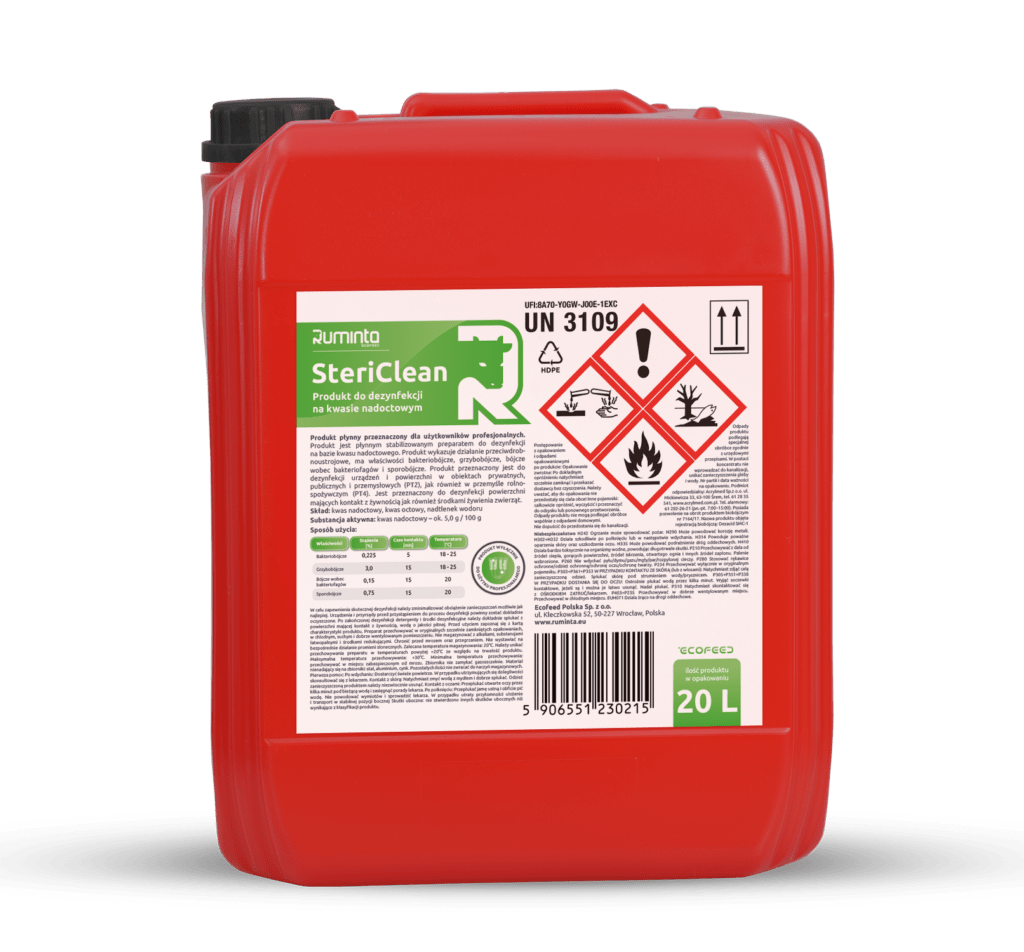
A good product for disinfecting surfaces and milking equipment should have a broad effect – not only on bacteria, but also on fungi and spores, which are much more difficult to eliminate. An example of such a solution is SteriClean A peracetic acid-based product developed for professional use on livestock farms. It effectively eliminates bacteria, fungi, bacteriophages, and spores, and its formula (peracetic acid, acetic acid, hydrogen peroxide) allows for effective use even at low concentrations.
A practical checklist for the milking parlor
- Clean and disinfect the milking system after each milking, according to the equipment manufacturer's recommendations.
- Select the concentration of the preparation for the specific application (surfaces, devices, installation) - do not use a "universal" dilution for everything.
- Check the expiration date and storage method of disinfectants.
- Keep a simple disinfection log – this makes it easier to spot irregularities when mastitis cases spike in your herd.
You can find more information about SteriClean and its dosage at SteriClean | Ruminta®


