The European Union milk market has undergone a significant change over the past dozen or so months. As recently as the summer of 2025, the average milk price exceeded €53/100 kg. A year later, we're already at around €42/100 kg. However, the latest data offer a slight sign of improvement: after a long period of decline, the EU average rose for the second consecutive month.
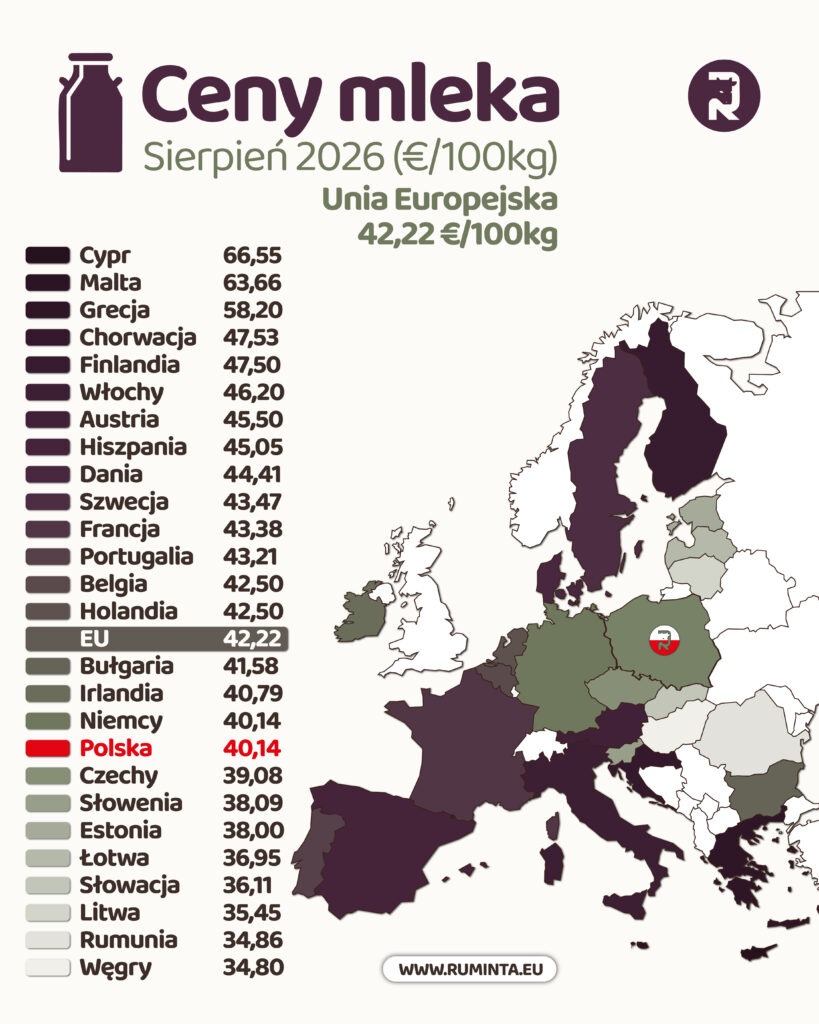
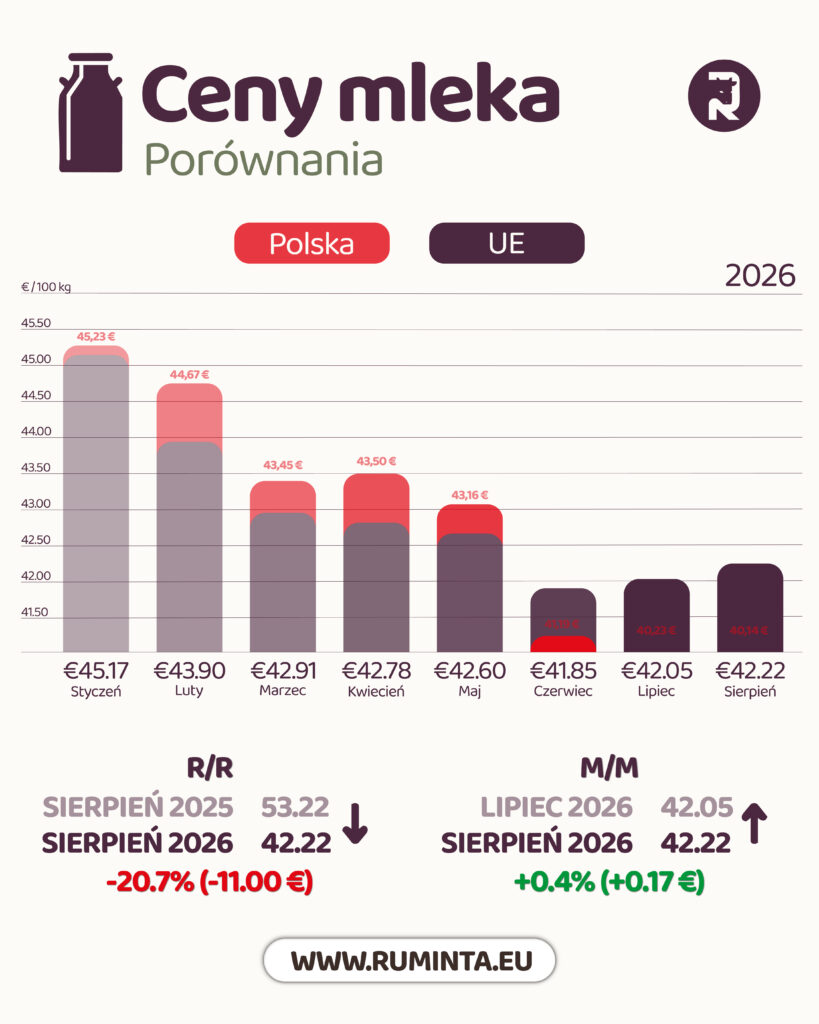
According to data from the Milk Market Observatory, the estimated average EU milk price in August 2026 was €42.22/100 kg. In July, it was €42.05 and in June, €41.85. This represents an increase of approximately 0.4% month-on-month. The movement itself is small, but its direction is significant – after a deep correction, the market has stopped setting further lower levels for now.
Compared to last year, prices are still very low
Stabilization can be seen primarily on a month-to-month basis. A year-to-year comparison shows how significantly the situation for breeders has changed.
In August 2025, the average price in the EU was €53.22/100 kg. The current €42.22 represents a decrease of exactly €11/100 kg, or approximately 20.7% year-on-year.
The decline is therefore still very much felt on farms. This is especially true given that lower milk prices do not automatically translate into an equally rapid decline in production costs. The European Commission is highlighting, among other things, the risks associated with energy, transport, and fertilizer costs, which could continue to put pressure on producer margins.
Poland: €40.14/100 kg and still below the EU average
In Poland, the estimated price for August is €40.14/100 kg. In July, it was €40.23, a slight decrease of about 0.2% m/m.
A much larger difference is visible on a year-over-year basis. In August 2025, the Polish price was €53.36/100 kg. This represents a decrease of €13.22/100 kg, or approximately 24.81 TP3T over the year.
Poland also remains below the EU average. The difference currently stands at €2.08/100 kg, or approximately 4.91 TP3T.
The situation is interesting when compared to our EU neighbors. Germany has exactly the same level as Poland – €40.14/100 kg. In the Czech Republic, it's €39.08, in Slovakia €36.11, and in Lithuania €35.45.
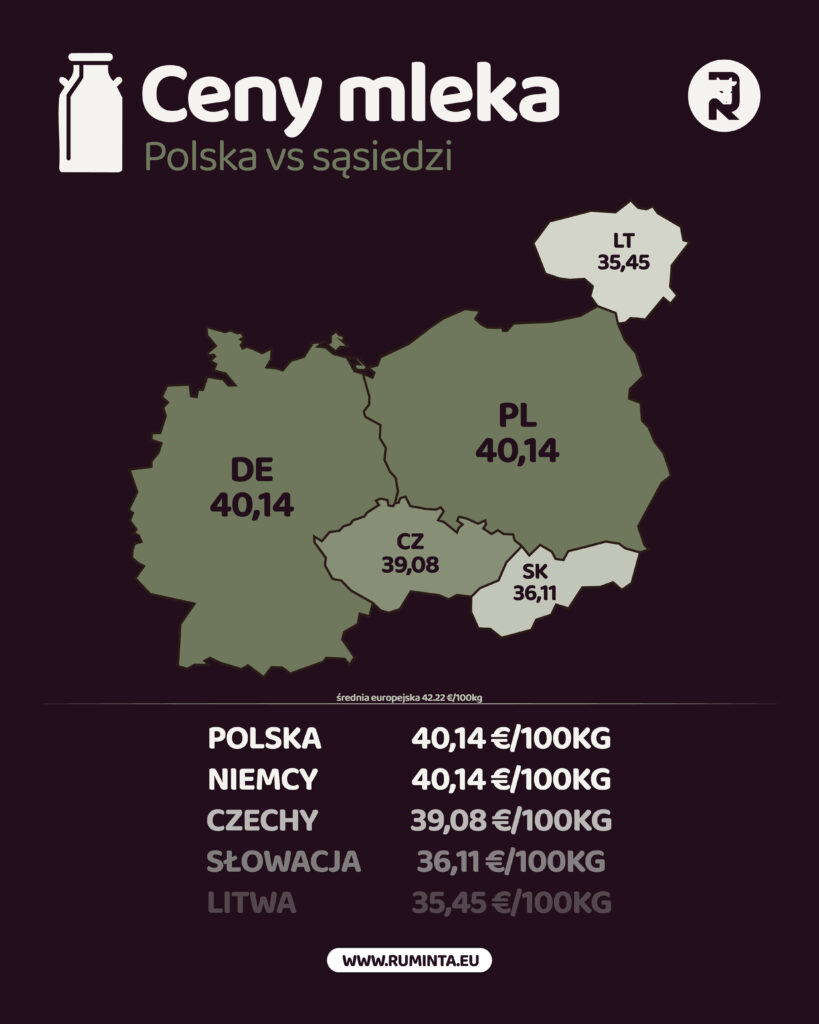
Poland therefore ranks above the Czech Republic, Slovakia, and Lithuania, and on par with Germany. At the same time, all of these markets remain significantly below the EU average.
Where is milk currently the most expensive?
The differences between individual countries are very large.
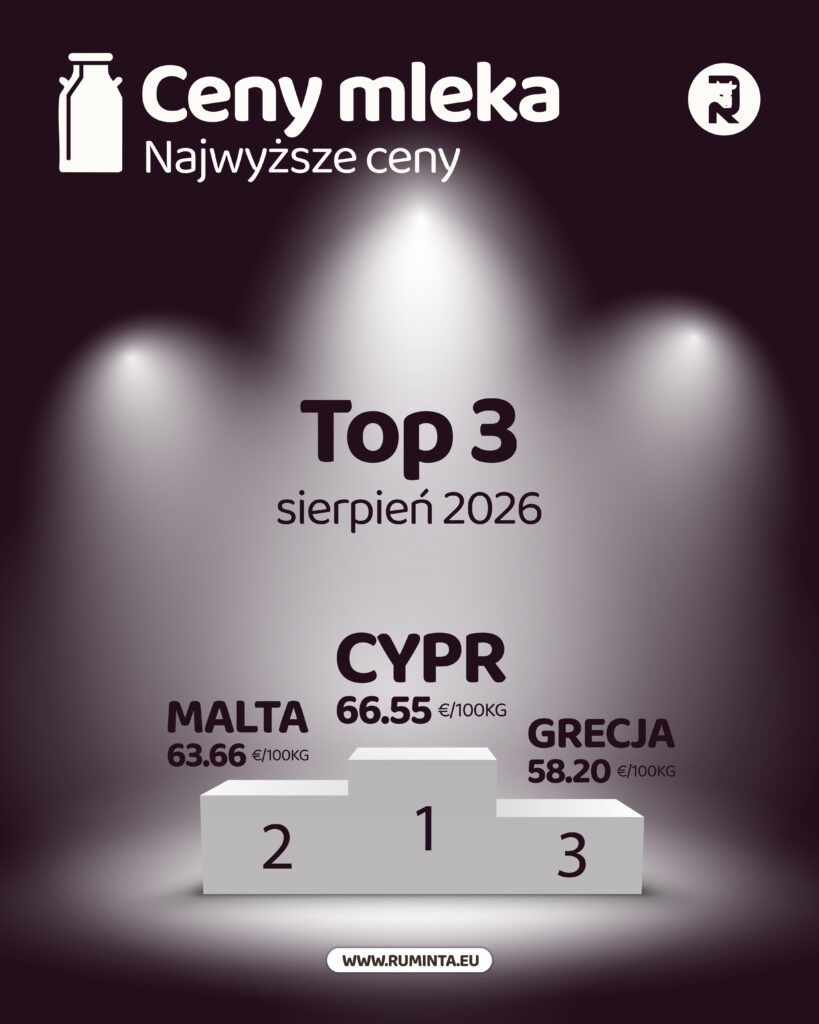
Cyprus remains the leader of the ranking with €66.55/100 kg. Malta is second with €63.66, and Greece is third with €58.20.
Only then do we see a significant decline. Croatia reaches €47.53, Finland €47.50, and Italy €46.20.
At the other end of the list were Hungary with €34.80/100 kg, Romania with €34.86, and Lithuania with €35.45. Next came Slovakia with €36.11 and Latvia with €36.95.
The difference between the most expensive and cheapest countries is over €31/100 kg. This demonstrates that there is no single "European milk price." The final price is influenced by local supply, the structure of the dairy market, production costs, milk parameters, export opportunities, and the specific characteristics of individual countries.
Why have prices dropped so much?
One important piece of the puzzle is milk supply. In the first half of 2026, EU milk supplies were approximately 3.41 TP3 tons higher than a year earlier. In Poland, the increase between January and June was approximately 3.31 TP3 tons year-on-year. June alone saw a year-on-year increase in supplies across the EU.
This is important because more raw material going into processing increases pressure on the market – especially if demand does not grow at the same rate.
The European Commission indicates that high production in 2025 and early 2026 was the result of several factors simultaneously: previously high milk prices and good farm margins, favorable weather conditions, good feed availability and changes in the production cycle of some herds.
The dairy market is sending mixed signals
At the beginning of September, the situation on the dairy products market is not clear.
The price of skimmed milk powder (SMP) in the EU was around €306/100 kg, up €29% from a year earlier. Whey powder was €52% more expensive year-on-year.
On the other hand, butter cost around €411/100 kg, a whopping €38% less than a year earlier. Prices for many cheeses also remained lower: Gouda was around €21% cheaper year-on-year, Edam was €22% cheaper, and Cheddar was €28% cheaper.
So we have a two-speed market. Some products are starting to provide dairies with a better price signal, but other segments remain under intense pressure. From the milk producer's perspective, this means that any rebound in raw material prices may be gradual, not abrupt.
What might happen in the coming months?
The official forecast of the European Commission gives grounds for cautious expectations of stabilization, but does not announce a quick return to the levels of 2025.
The Commission estimates that after the decline in milk prices observed since autumn 2025, the stabilization and, in some places, the increase in prices of dairy products may, with some delay, also translate into raw material prices.
At the same time, total EU milk production is expected to increase by only around 0.21 TP3T in 2026. After a very strong first half of the year, the Commission expects that production may decline year-on-year in the second half.
If supply does indeed begin to decline and demand for dairy products remains stable, this will support milk prices. However, this does not automatically mean a rapid increase in procurement rates.
It's also worth emphasizing that the August data itself is labeled as estimates by the European Commission and should not be considered a forecast of future prices. The market forecast described above comes from a separate short-term outlook from the European Commission.
What does this mean for the Polish breeder?
The most important signal today is not so much the price increase, but rather the slowdown in earlier declines across the EU. Poland hasn't yet shown a clear rebound – August prices were marginally lower than July – but the pace of change is significantly slower than a few months ago.
Given current prices, controlling the cost of producing a single liter of milk is particularly important. With the purchase price nearly 251 TP3T lower than a year ago, even small differences in feed utilization, herd performance, culling, milk quality, or the number of health problems have a much greater impact on the farm's bottom line.
For now, we can speak of the first signs of stabilization in the European market, but not yet of a lasting recovery. The coming months will reveal whether the reduction in production dynamics and improvements in some dairy market segments will be enough to trigger a more significant increase in milk prices.