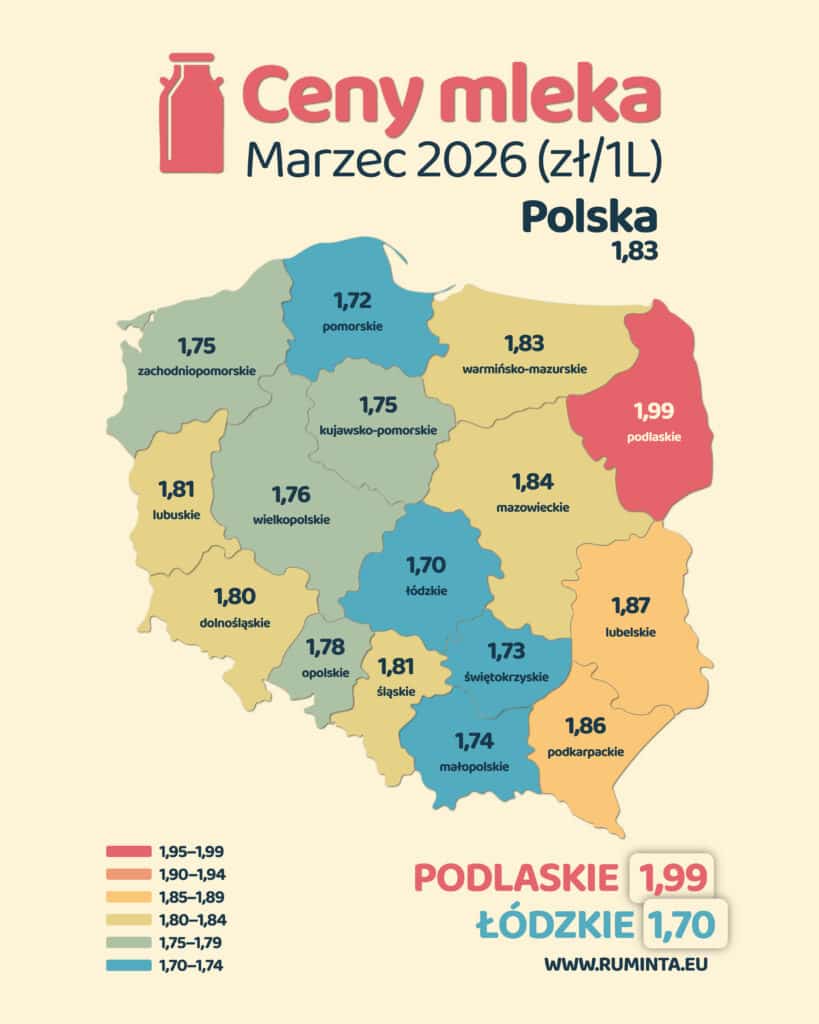
The purchase prices of cow's milk in Poland fell in March 2026 to PLN 1.83/l – that's 1.7% less than in February and 19.6% less than a year earlier. Data published on April 23, 2026 by the Central Statistical Office (GUS) show clear regional differences: between the most expensive and cheapest voivodeships, the difference reaches almost 0.30 PLN per liter.
What does the latest Central Statistical Office data on milk prices say?
According to the report Agricultural product prices in March 2026 (GUS, 23/04/2026), the purchase price of cow's milk was 183.23 PLN/hl (1.83 PLN/l)This result is worse both on a monthly basis (-1.7% compared to February 2026) and on an annual basis (-19.6% compared to March 2025).
Milk is the weakest performer among all basic agricultural products monitored by the Central Statistical Office – while most categories rebounded month-on-month in March, milk purchase prices continued their downward trend. This is a wake-up call for producers, especially in the context of rising production costs.
Milk purchase prices by voivodeship - ranking March 2026
Below we present the full ranking of voivodeships from the highest to the lowest milk purchase price (GUS data, excluding VAT):
| Rank | Voivodeship | Purchase price (z?/l) |
|---|---|---|
| 1 | Podlaskie | 1,99 |
| 2 | Lublin Voivodeship | 1,87 |
| 3 | Subcarpathia | 1,86 |
| 4 | Masovian Voivodeship | 1,84 |
| 5 | Warmia-Masuria | 1,83 |
| 6 | Silesian | 1,81 |
| 7 | Lubusz | 1,81 |
| 8 | Lower Silesia | 1,80 |
| 9 | Opole Voivodeship | 1,78 |
| 10 | Greater Poland | 1,76 |
| 11 | Kuyavian-Pomeranian Voivodeship | 1,75 |
| 12 | West Pomeranian Voivodeship | 1,75 |
| 13 | Lesser Poland Voivodeship | 1,74 |
| 14 | Holy Cross | 1,73 |
| 15 | Pomeranian Voivodeship | 1,72 |
| 16 | Lodz Province | 1,70 |
Podlaskie is once again the leader. The Podlaskie Voivodeship achieved the highest purchase price in the country – PLN 1.99/l, which is 16 groszy above the national average. This is the result of a strong concentration of specialized dairy farms and large dairies (including SM Mlekovita and OSM Pi?tnica), which, thanks to their large purchasing scale, offer better pricing to suppliers.
Łódź at the bottom of the table. The lowest purchase price was recorded in the Łódź Voivodeship – 1.70 PLN/l, which is as much as 29 groszy less than in Podlaskie. With a monthly production of several tens of thousands of liters, this difference translates into a very noticeable loss of revenue.
Changes in milk prices month to month – who gains, who loses?
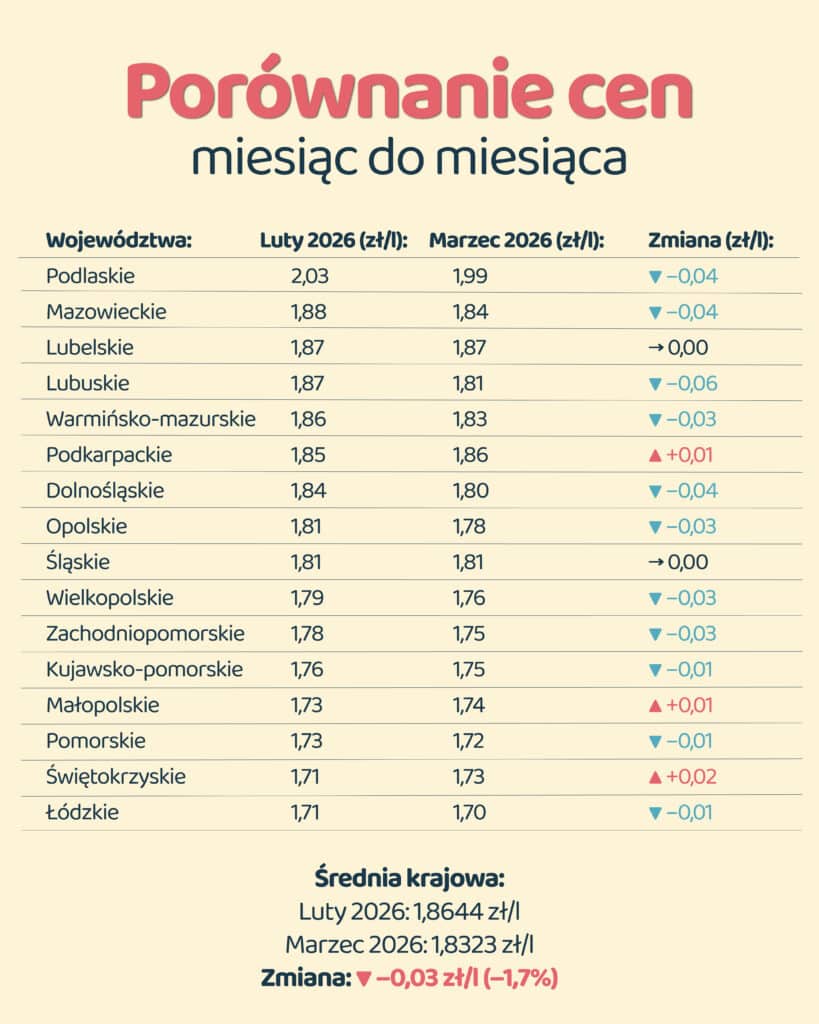
Comparing March 2026 with February 2026, only 3 voivodeships recorded an increase milk purchase prices:
- Holy Cross ? +0.02 z?/l
- Subcarpathia ? +0.01 z?/l
- Lesser Poland Voivodeship ? +0.01 z?/l
The remaining 13 voivodeships recorded declines or stabilization. The largest monthly decline occurred in Lubusz (? ?0.06 z?/l), and right behind it Podlaskie, Masovian and Lower Silesian Voivodeships (? 0.04 PLN/l each).
Why have milk purchase prices fallen so much year on year?
The nearly 20% year-on-year decline is one of the largest in recent years for this commodity. Several factors contributed to this decline:
1. High Base 2025 March 2025 was a month of exceptionally high milk purchase prices—likely close to the local peak of the dairy market price cycle. The current level represents a correction after that period.
2. Oversupply of milk in Europe. Throughout 2025 and early 2026, European markets struggled with a surplus of raw materials, particularly in Germany, the Netherlands, and Poland. Increased herd productivity coupled with weakening export demand (including from China and the Middle East) put pressure on procurement prices.
3. Falling demand for dairy products. Changes in consumption habits – the growing popularity of plant-based beverages and general inflationary pressure limiting purchases – have reduced the dairy industry's demand for raw materials.
4. Production costs remain high. Paradoxically, despite the decline in purchase prices, milk production costs (feed, energy, fertilizers) remain elevated. This translates into increasing pressure on farmers' margins.
How do milk purchase prices compare to retail prices?
It is worth noting that the Central Statistical Office data concern only purchase prices – that is, prices paid to farmers by dairies and intermediaries (excluding VAT). Retail prices of milk in stores are much higher and depend on the margins of processors, distributors, and retail chains.
Market data for milk are not monitored by the Central Statistical Office in the same way as in the case of cereals or potatoes.
Summary – what awaits the milk market in Poland?
March 2026 brought a continuation of the negative price trend for milk producers in Poland. With a 19.6% drop year-on-year and another month-on-month price reduction, the income situation of dairy farms is difficult – especially smaller ones without long-term contracts with dairies.
Key takeaways:
- The average purchase price of milk in Poland in March 2026 was 1.83 PLN/l
- The most expensive was paid in Podlasie (1.99 PLN/l), cheapest in Lodz (1.70 PLN/l)
- Only 3 voivodeships recorded an increase month-on-month: Świętokrzyskie, Podkarpackie and Małopolskie
- Year-on-year decline of ?19,6% This is the highest result among all basic agricultural products.
Market observers point out that stabilization of milk purchase prices will only be possible with a reduction in supply on a European scale or a significant revival of dairy product exports.
Data source: Central Statistical Office, "Prices of agricultural products in March 2026", published on April 23, 2026. Own study based on Central Statistical Office data.